

Short answer: Online fitness coaching is worth it when you get three things: real accountability, a programme built for your body and schedule, and regular feedback on your form and your food. It is not worth it if all you get is a PDF and a chat number. The difference is whether someone is actually coaching you, week after week.
If you are a busy 30-50 year-old professional who has tried an app, a YouTube series or a ChatGPT plan and stalled, this guide is for you. It is an honest look at what a real coach should do, who does not need one, and how to tell a good coach from a bad one before you pay.
What online fitness coaching actually is
Online fitness coaching is personalised training, nutrition and lifestyle coaching delivered remotely. You train where you are, at home, in a hotel gym or at your local gym, and your coach plans, reviews and adjusts the work from a distance.
Online coach vs in-person personal trainer
A personal trainer stands next to you for an hour. An online coach is with you across the whole week: your sessions, your meals, your sleep and the weeks when work takes over. You lose the hands-on spotting, but you gain flexibility and a coach who sees the bigger picture of your life, not just one hour of it.
Online coach vs a free app, YouTube or ChatGPT plan
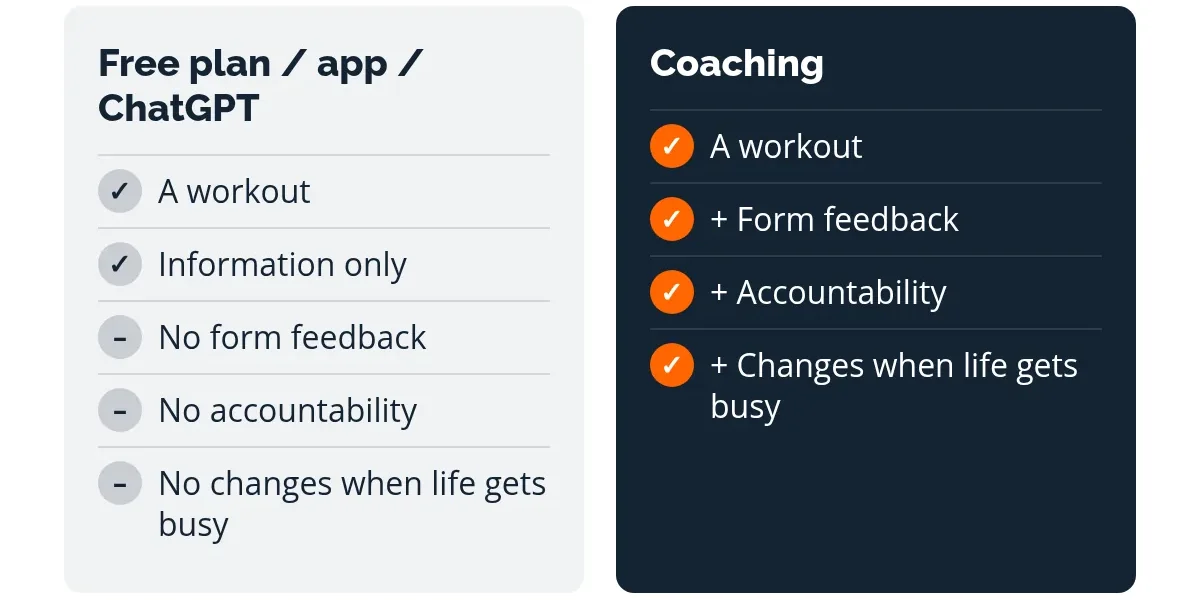
A free plan can give you a reasonable workout. What it cannot do is watch you squat, notice that you skipped three sessions during a deadline week, or change your plan because a lift doesn’t feel right. A plan is information. Coaching is information plus feedback plus accountability, adjusted to you.

When online coaching is worth the money
You know what to do but don’t do it consistently
Most busy people do not lack information. They lack a system that keeps them going when motivation dips. You are not alone in this. According to the World Health Organization (WHO), 31% of adults do not meet the recommended levels of physical activity. A scheduled weekly check-in with a real person is often the difference between starting over every January and actually building momentum.
Your schedule, travel or location makes in-person training hard
If you travel for work, live somewhere without a coach you trust, or simply cannot commit to fixed gym appointments, online coaching lets the programme fit around your life instead of the other way round.
You want to learn, not depend on a coach forever
A good coach teaches you why you are doing what you are doing. Over time you should understand your training and nutrition well enough to run them on your own.
“I’m not just handing you a fish. I’m teaching you how to fish.” — Pankaj Narsian, Head Coach, Layman Fitness
“Working with Pankaj has helped me build a much more balanced and realistic approach towards health and fitness. Over the years, we have worked on my training, lifestyle, and overall health in a way that could fit around my responsibilities as a business owner, mother, and someone with a very busy schedule. What stood out most was that the coaching never felt rigid or unrealistic. We always adjusted things based on my stress levels, energy, travel, or workload, which helped me stay much more consistent in the long run.” — Meghana Bhat, Co-founder, Early.partners
When it is NOT worth it
Be honest with yourself. Online coaching is probably not for you if:
- You want a quick fix or rapid results.
- You are not willing to follow a structured process.
- You want a coach to do the work for you.
- You are not ready to be honest about your habits.
- You already train consistently, progress steadily and enjoy programming for yourself.
If that last point is you, save your money. Coaching is for people who want a system and a teacher, not for people who already have both.
What a good online coach should include
A personalised programme in a tracking app
Your plan should be built around your equipment, schedule, training history and goals, and delivered in an app where you log every session. That record lets your coach make decisions on data, not guesswork.
Form checks through video feedback
How can a coach correct your form online? You film key sets, upload them, and your coach replies with specific corrections, cues and progression advice. Done every week, this builds real skill and confidence under the bar.
Nutrition and lifestyle check-ins with your own food
Nutrition coaching should work with the food you actually eat, including Indian home food, business dinners and family meals. It should also look at sleep, daily movement and stress, because those shape your progress as much as your workouts do.
A scheduled call, not just chat replies
WhatsApp messages are useful, but a scheduled call is where real problem-solving happens. Ask whether calls are weekly, how long they are and what gets reviewed.
Red flags to watch for
What are the red flags of a bad online fitness coach? Watch for these:
Same plan for everyone, or an instant PDF
If you receive your “personalised” plan minutes after paying, nobody looked at your history. Real personalisation starts with questions and an assessment.
Before-after photos with no story or credentials
Photos alone tell you nothing about how the result was achieved, how long it took or whether it lasted. Look for recognised certifications and client stories in the clients’ own words.
Extreme diets, “detox” and supplement upsells
Very low-calorie plans, cutting out entire food groups for no reason, detox teas and a supplement for every problem are all warning signs. A good coach teaches you to eat well in your real life.
No form feedback, no check-ins
If nobody ever watches you train or asks how your week went, you are paying for a document, not coaching.
Questions to ask before you pay
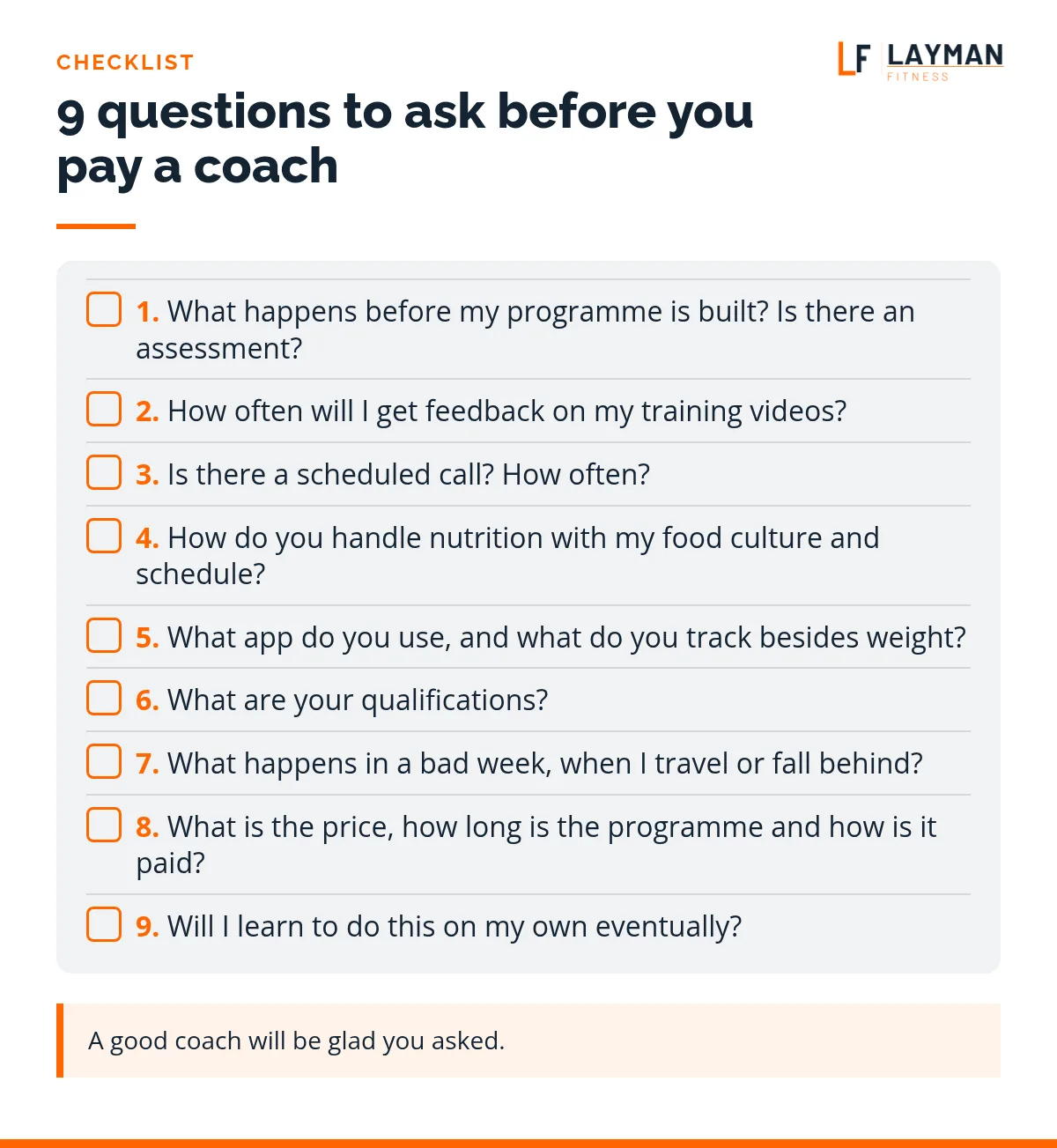
Use this checklist on any coach you are considering, including us:
- What happens before my programme is built? Is there an assessment?
- How often will I get feedback on my training videos?
- Is there a scheduled call? How often?
- How do you handle nutrition with my food culture and schedule?
- What app do you use, and what do you track besides weight?
- What are your qualifications?
- What happens in a bad week, when I travel or fall behind?
- What is the price, how long is the programme and how is it paid?
- Will I learn to do this on my own eventually?
A good coach will be glad you asked.
How Layman Fitness coaches online
All Layman Fitness coaching is delivered online, and it runs on three pillars that work together:
- Accountability: data-driven check-ins on sleep, steps, stress, food and training, not just the scale.
- Personalised Training: workouts built for your equipment, schedule and body, delivered in the CoachRx app.
- Metabolic Health: nutrition designed around your biology, cultural preferences and real lifestyle.
Every week, three things happen: a weekly or bi-weekly accountability and education call, feedback on your uploaded training videos, and a nutrition and lifestyle check. The full programme is described on our online fitness coaching page, and you can read more about how our check-ins and form reviews work.
Pricing: 3-month programme ₹25,000 and 6-month programme ₹45,000, both paid upfront in INR. Programmes are paid upfront because a structured programme has a beginning, a middle and a clear end, and committing to the full stretch is part of the process.
In our clients’ own words:
“His approach is structured and thorough, with a strong emphasis on building a strong foundation.” — Namita Shirgaonkar, Client Partner, ABC Consultants
“Pankaj has always helped me find the right balance so I can stay consistent without overdoing it.” — Anoop Menon, Ad tech × Creative × Culture
Read more client stories. If you want to start with the basics on your own first, our free guides are on the resources page.
Ready to see if it fits? Tap the WhatsApp button on our site to message us. Tell us your goal and your schedule, and we will tell you honestly whether coaching makes sense for you.
FAQs
Is online fitness coaching worth it? Yes, if it includes a personalised programme, regular form feedback, nutrition check-ins and a scheduled call. If it is a generic plan with no follow-up, it is not worth paying for.
What is the difference between an online coach and a personal trainer? A personal trainer works with you in person for a session at a time. An online coach plans and reviews your training, nutrition and lifestyle across the whole week, remotely, wherever you are.
Can a ChatGPT or app workout plan replace a coach? It can give you a starting plan. It cannot watch your form, hold you accountable or adapt to your life the way a coach does week to week.
How can a coach correct my form online? You upload videos of key sets and your coach replies with specific corrections, cues and load advice. Done weekly, this builds real skill over time.
How long should I work with an online coach? Long enough to build habits and learn the system, which is why good coaching is structured as a programme rather than a few sessions. Progress is individual, so be wary of anyone who promises a fixed timeline.
What should an online coaching package include? An assessment, a personalised programme in an app, regular video feedback, nutrition and lifestyle check-ins, and a scheduled call with your coach.
Sources
- World Health Organization (WHO). “Physical activity” (fact sheet). WHO, 26 June 2024. https://www.who.int/news-room/fact-sheets/detail/physical-activity
- Layman Fitness. “Online Fitness Coaching.” Layman Fitness. https://laymanfitness.com/online-fitness-coaching/
- Layman Fitness. “How It Works.” Layman Fitness. https://laymanfitness.com/how-it-works/