

Disclaimer: This article is general fitness education. It is not medical advice, diagnosis or treatment. If you have back pain, see a doctor or physiotherapist before you start training, and see one straight away if you notice any of the red-flag symptoms listed below.
Many people with a stiff or sore lower back can train with weights, but only after a doctor or physiotherapist has ruled out anything serious. Start with light, controlled movements for your hips, trunk and upper back, progress slowly, and stop and get checked if symptoms get worse.
Desk work, sitting and a stiff lower back
If you sit for eight or nine hours, you know the feeling: stiff after a long call, slower getting out of the car by Friday, sore after weekend cricket or a long drive. You may not feel injured, just stiff and unsure — with one big question: should I lift weights, or will that make it worse?
This guide does not tell you why your back hurts. Only a doctor or physiotherapist who examines you can do that. The NHS notes that lower back pain is very common, and that the cause is not always obvious. That is why the first step is a medical check, not a workout.
When to see a doctor first
Before any exercise, know the warning signs. According to the NHS back pain page, you should get emergency medical help if you have back pain together with (UK NHS guidance; in India call 112 or go to the nearest emergency department):
- pain, tingling, weakness or numbness in both legs
- a loss of feeling around your genitals or anus
- changes in your bladder or bowels, such as difficulty peeing, or peeing or pooing yourself
- changes in how your penis or vagina feels during sex, not being able to get or keep an erection, or not being able to orgasm
- chest pain
- it started after a serious accident, such as a car accident
The NHS also advises an urgent doctor’s appointment if you feel hot, cold, shivery or generally unwell, or if the pain is severe and starts suddenly, or is getting worse quickly.
And it advises seeing a doctor if you have back pain and:
- it does not improve after treating it at home for a few weeks
- it’s stopping you doing your day-to-day activities
- you’re worried about the pain or you’re struggling to cope
- you’ve lost weight without trying to
- there’s a lump or swelling in your back, or your back has changed shape
- it does not improve after resting or is worse at night
- it’s worse when sneezing, coughing or pooing
- it’s coming from the top of your back (between your shoulders), rather than your lower back
If any of these apply, close this article and see a doctor. Training can wait.
Where strength training fits
We are fitness coaches, not doctors or physiotherapists. We do not diagnose back pain, and we do not claim that any exercise will make it go away. The NHS advises people with back pain to stay active and keep up daily activities, and not to stay in bed for long periods — and to stop any exercise that makes the pain worse. NICE guideline NG59 similarly recommends “encouragement to continue with normal activities” (recommendation 1.2.1).
Strength training, in that context, is about building a body that is strong and capable in everyday movements. First a doctor or physiotherapist checks you. Then, with their go-ahead, you train carefully over months, not days.
How to start: principles
Start pain-free or with low discomfort, and progress slowly
Pick movements you can do comfortably today. If a movement causes sharp pain or makes symptoms worse, stop and talk to your physiotherapist. Add load, reps or range slowly, week by week.
Know your pain triggers
Dr Stuart McGill, professor emeritus at the University of Waterloo and author of Back Mechanic, recommends finding your pain triggers: the movements, postures and loads that make symptoms worse. Avoid those for now. Treat each new exercise as a test: if it feels fine, continue; if it doesn’t, adjust or swap it.
Train the hips, trunk and upper back, not just “the core”
A well-rounded programme trains the whole chain: glutes and hips that drive a hinge, trunk muscles that keep you steady, and the upper back that holds posture through the day. McGill advises against crunches and sit-ups, which bend the spine under load, and against knee-to-chest back stretches.
Movement breaks during the workday
Your training session is about 45 minutes; your workday is nine hours. Set a reminder to stand up, walk to the water cooler or take a call on your feet. McGill’s view is that no single sitting posture stays ideal for long — the best posture keeps changing, and nothing beats getting out of the chair.
Beginner exercises to start with
Get your physiotherapist’s go-ahead first. Start with bodyweight or very light load, two or three sets, and stop if anything feels wrong.
Hip hinge drill
How to: Stand with feet hip-width apart and hold a broomstick along your back, touching your head, upper back and tailbone. Push your hips back, keep a soft bend in the knees and lower your chest until you feel a stretch in your hamstrings. Stand back up by pushing your hips forward.
Common mistake: Bending from the lower back instead of the hips. If the stick leaves your head or tailbone, you have lost position.
“We want you to move at the hip and keep your back in a neutral position at the same time.” And: “Forward lean is never an issue as far as the spine is kept neutral.” — Pankaj Narsian, Head Coach, Layman Fitness
Glute bridge
How to: Lie on your back, knees bent, feet flat. Squeeze your glutes and lift your hips until your body is in a line from shoulders to knees. Pause, then lower slowly. Keep the hamstrings quiet.
Common mistake: Avoid overarching the lower back (lumbar spine) to get the hips higher. Stop when your glutes are fully squeezed.
Bird dog
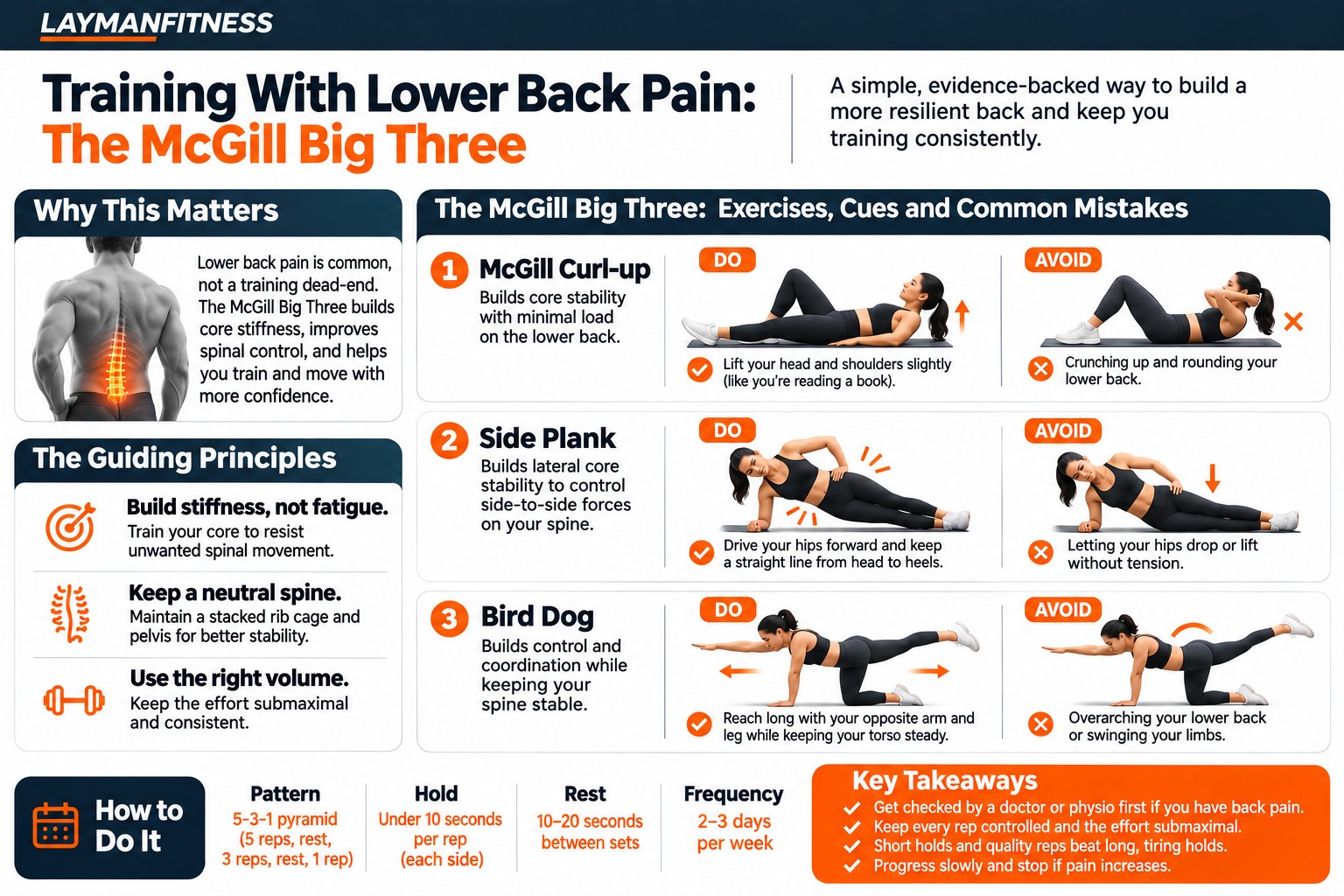
How to: Start on hands and knees. Reach one arm forward and the opposite leg back until both are level with your body. Hold for about 8 to 10 seconds, hips level with no twisting, then switch sides.
Common mistake: Rushing and letting the hips twist. Imagine a cup of tea on your lower back that you must not spill.
Side plank
How to: Lie on your side, elbow under your shoulder, knees bent (easier) or legs straight (harder). Lift your hips so your body forms a straight line. Hold about 8 to 10 seconds, rest, repeat, then switch sides. Build up with more reps, not longer holds.
Common mistake: Letting the hips sag or roll backwards. Keep them stacked and lifted.
Curl-up
How to: Lie on your back with one knee bent and the other leg straight, hands under your lower back. Lift your head, shoulders and chest slightly off the floor as one unit. Hold about 8 to 10 seconds, lower, and switch legs halfway through your reps.
Common mistake: Bending the neck or tucking the chin. Keep head and neck in line.
The bird dog, side plank and curl-up are McGill’s “Big 3”. He recommends holds under 10 seconds, built up with more reps. In Harvard Health Publishing’s “Three moves for better spine health” (1 August 2020), physical therapist Eric L’Italien suggests a descending “pyramid” pattern: 5 reps of each, then 3, then 1, two or three days a week.
Goblet squat to a box
How to: Add once the bridge and hip hinge feel solid. Hold one 8 kg dumbbell at your chest. Stand in front of a box or chair, sit back until you lightly touch it, then stand by pushing through your whole foot.
Common mistake: Dropping onto the box or rounding forward. Touch lightly, stay tall, keep the spine neutral.
Rows
How to: Grab a dumbbell with one hand with one knee supported on a bench. Maintain a neutral spine position, breathe out and pull lateral to your lower ribs, pause for a second and then lower the weight under control.
Common mistake: Yanking with the lower back or shrugging.
Deadlifts and loaded hinges: what to know
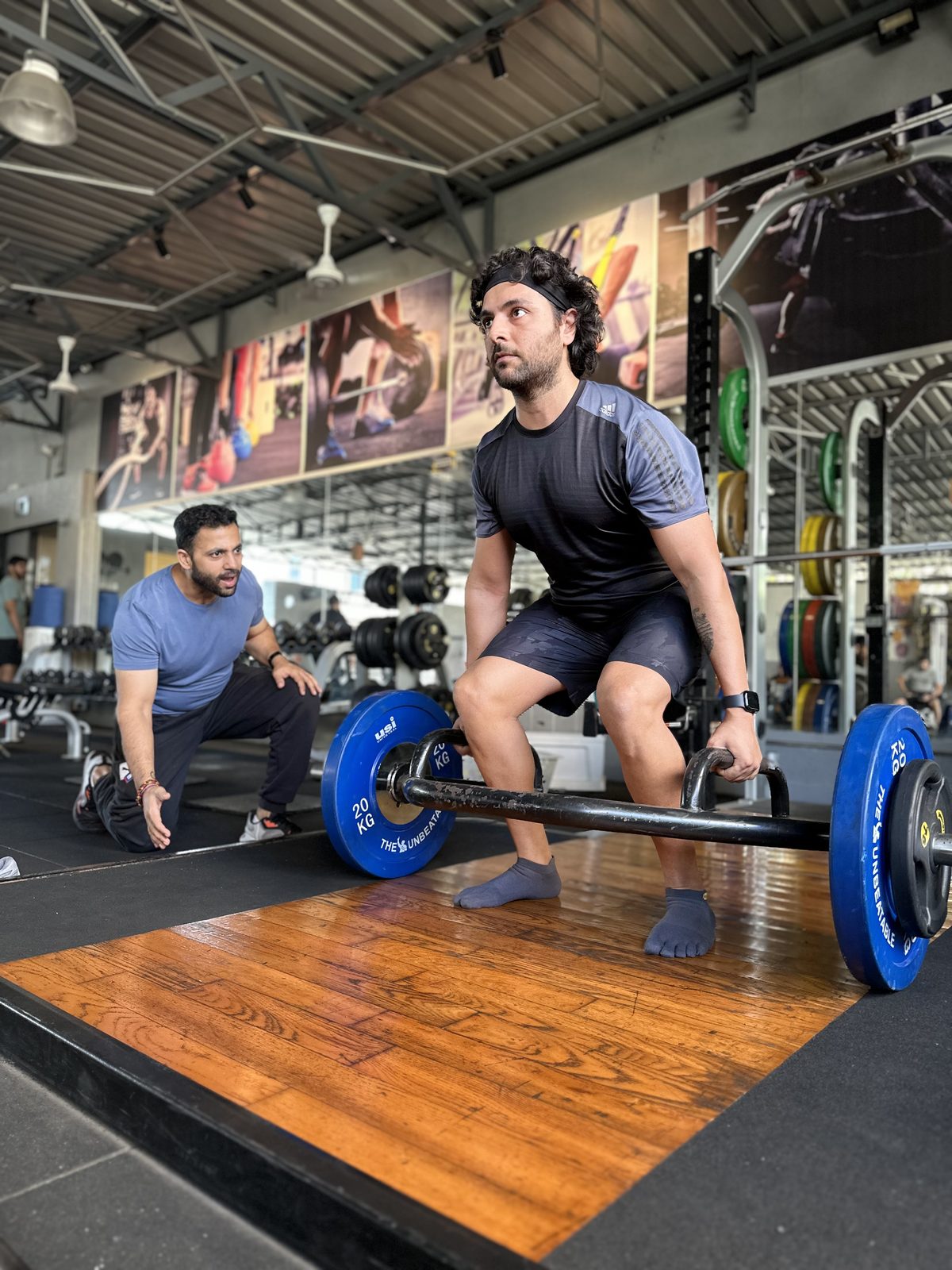
We make no safety promises about any exercise for anyone with back pain. If you want to deadlift: get clearance from your physiotherapist; learn a solid, pain-free hip hinge with a broomstick then light weight; and have someone watching your form. Coaches often introduce loaded hinging with a kettlebell or trap-bar from raised blocks — whether that suits you is a call for your physiotherapist and coach together. McGill describes back training as staged: foundation and endurance first; heavier strength work later.
How remote coaching helps
You need someone who sees how you move and adjusts your plan as you go. At Layman Fitness, coaching is fully online and built on three pillars: Accountability, Personalised Training and Metabolic Health. The coach is based in India and works with clients remotely. You film your sets; we review them and send feedback. See how we check your form by video. Your programme lives in CoachRx and is adjusted week to week. Read more about our online fitness coaching.
If you have been cleared to train and want a programme built around your desk job, fill in our Coaching Application form (the “Apply for a free call” button on our site) and tell us where you are starting from.
FAQs
Should I lift weights if I have lower back pain?
See a doctor or physiotherapist first. The NHS advises staying active and stopping any exercise that makes the pain worse. If cleared, start light and progress slowly with good form.
What are good exercises to start with if I sit all day?
With your physiotherapist’s go-ahead: hip hinge drill, glute bridge, bird dog, side plank, curl-up, goblet squat to a box and rows. Stop any exercise that makes symptoms worse.
Is deadlifting safe for lower back pain?
No one can promise any exercise is safe for every person with back pain. Get clearance, learn a clean hip hinge first, and have a coach check your form before adding load.
When should I see a doctor for lower back pain?
Get emergency help straight away (UK NHS guidance; in India call 112 or go to the nearest emergency department) for the red-flag symptoms listed above, including pain, tingling, weakness or numbness in both legs, loss of feeling around your genitals or anus, bladder or bowel changes, chest pain, or pain after a serious accident. See a doctor if pain does not improve after a few weeks at home, stops day-to-day activities, or is worse at night. Full list: NHS.
Is walking good for lower back pain?
The NHS advises staying active and lists walking, swimming, yoga and pilates among suggested activities. Stop if pain gets worse and see a doctor. McGill’s Waterloo position paper notes that many people whose back pain is aggravated by sitting feel better with frequent posture changes and brisk walking. Ask your doctor or physiotherapist what is right for you.
Sources
- NHS. Back pain. NHS website, page last reviewed 5 March 2026. https://www.nhs.uk/conditions/back-pain/
- National Institute for Health and Care Excellence (NICE). Low back pain and sciatica in over 16s: assessment and management (guideline NG59), recommendation 1.2.1. https://www.nice.org.uk/guidance/ng59/chapter/Recommendations
- Stuart McGill. Designing Back Exercise: From Rehabilitation to Enhancing Performance. BackFitPro. https://www.backfitpro.com/designing-back-exercise-from-rehabilitation-to-enhancing-performance/
- Stuart McGill. There Is No Such Thing as “Non-Specific Back Pain” (position paper CRE-MSD 4164-1). Centre of Research Expertise for the Prevention of Musculoskeletal Disorders, University of Waterloo, 2016. https://uwaterloo.ca/centre-of-research-expertise-for-the-prevention-of-musculoskeletal-disorders/sites/default/files/uploads/documents/4164-1_position_paper_2016_-_mcgill_non-specific_back_pain.pdf
- Stuart McGill. Back Mechanic: The Step-by-Step McGill Method to Fix Back Pain. BackFitPro, 2015. https://www.backfitpro.com/books/back-mechanic-the-mcgill-method-to-fix-back-pain/
- Stuart McGill. The Science of Stress: How to Reduce Back Pain While Sitting (white paper). Secretlab. https://assets.secretlab.co/assets/WhitePaper_McGill_The_Science_Of_Stress.pdf
- Harvard Health Publishing (Harvard Medical School). Three moves for better spine health (quoting Eric L’Italien, PT, Spaulding Rehabilitation). 1 August 2020. Verified live 7 Nov 2026. https://www.health.harvard.edu/healthy-aging-and-longevity/three-moves-for-better-spine-health
- Stuart M. McGill and Amy Karpowicz. Exercises for spine stabilization: motion/motor patterns, stability progressions, and clinical technique. Archives of Physical Medicine and Rehabilitation, 2009;90:118-126. https://www.backfitpro.com/medical-scientific-articles/2009/[90]McGill,S.(2009)Exercises-for-spine-stabilization[Arch.Phys.Med.and-Rehab.].pdf
- Stuart M. McGill. Low back stability: from formal description to issues for performance and rehabilitation. Exercise and Sport Sciences Reviews, 2001;29(1):26-31. https://journals.lww.com/acsm-essr/Fulltext/2001/01000/Low_Back_Stability__From_Formal_Description_to.6.aspx
- Patricia Treble. The man who wants to kill crunches. Maclean’s, 19 January 2010. https://macleans.ca/society/health/the-man-who-wants-to-kill-crunches/