

Short answer: A working professional can lose fat with about three hours of training a week: two or three full-body strength sessions, more daily walking, enough protein at each meal, a modest calorie deficit and decent sleep. Consistency matters far more than long workouts. You do not need two-hour gym sessions or a crash diet.
This guide is for busy 30-50 year-olds with desk jobs, long hours and not much energy left at the end of the day. It gives you a plan you can actually run, explains why each piece matters, and shows you how to track progress without obsessing over the scale.
Why busy professionals struggle to lose fat
It is rarely about willpower. It is usually about the shape of your day.
- Time. Long hours and commutes leave little room for the gym, so training gets pushed to “next week”.
- Stress. Deadlines and meetings make it harder to stick to plans, and stressed people tend to reach for convenient food.
- Sleep. Late calls and screens cut into sleep, and tired people move less and snack more.
- Late dinners. Many professionals eat their biggest meal late, often after a long gap with little protein.
- Sitting. Most of the day is spent in a chair, so daily movement is very low even if you train.
The plan below works around each of these instead of pretending they do not exist.
There is also a hidden problem: most fitness advice is written for people with free time. It assumes you can train at the same hour every day, cook every meal at home and sleep eight hours without fail. When your week does not look like that, the advice feels impossible, so you either go all in for a fortnight or do nothing at all. Neither lasts.
Work travel makes this worse. A two-day client visit can mean early flights, hotel breakfasts, long dinners with the team and no gym you know. One trip turns into a lost week, and a lost week turns into “I’ll restart next month”. The fix is not more discipline. It is having a smaller version of the plan ready before you leave.
On the road, that smaller version looks like this:
Train short, not zero. A 20-30 minute bodyweight or hotel-gym session of squats, push-ups, rows with a band and lunges keeps the habit alive.
Walk wherever you can. Take the stairs, walk to nearby meetings and explore the area on foot in the evening.
Choose protein first at buffets. Eggs, curd, dal, paneer, chicken or fish, then vegetables, then the rest.
Plan one meal, not every meal. Decide in advance which dinner is the indulgent one and keep the others simple.
Protect sleep. Keep the same wake-up time as far as you can and keep screens out of bed.
When you get home, go straight back to your normal week. No punishment workouts, no starving to “make up” for the trip. The goal is to keep going, not to be perfect.
The 3-hours-a-week framework
2-3 full-body strength sessions (45-60 minutes)
Strength training is the backbone of the plan. Each session works the whole body with a few basic movement patterns: a squat, a hinge (such as a Romanian deadlift), a push, a pull and a carry or core exercise. Three sessions of about an hour is roughly three hours a week. Two sessions still work well in a busy month.
Strength training helps you keep muscle while you lose fat, makes everyday life feel easier, and gives you something to measure other than body weight. Start with weights you can control for 8-12 clean reps, and add a little load or a rep or two when the last set feels easy. For example, a goblet squat might start at 12 kg total (one 12 kg dumbbell) and move up from there.
Daily steps and movement breaks at your desk
Walking is the easiest way to burn more energy without adding stress or soreness. Take calls on the move, walk after lunch, use the stairs and stand up every hour. The World Health Organization recommends that adults get at least 150 minutes of moderate-intensity physical activity per week, and brisk walking counts towards that.
Daily step target: 8,000 to 9,000 steps
Optional short conditioning
If you have time and energy, add one or two short conditioning pieces of 20-30 minutes, such as brisk incline walking, cycling or a simple circuit at the end of a strength session. They are useful but optional. Do not let them replace strength work or sleep.
Sample week
Here is one way to lay out the week. Swap days around your meetings and travel.
| Day | Main session | Home option | Gym option |
|---|---|---|---|
| Monday | Full-body strength A (45-60 min) | Dumbbell goblet squat, push-ups, one-arm row, Romanian deadlift | Squat, bench press, cable row, Romanian deadlift |
| Tuesday | Steps and a walk after lunch | Walk | Walk or treadmill |
| Wednesday | Full-body strength B (45-60 min) | Split squat, overhead press, band pull-apart, hip thrust | Leg press, overhead press, lat pulldown, hip thrust |
| Thursday | Steps and optional 10-15 min conditioning | Brisk walk or circuit | Incline walk or bike |
| Friday | Full-body strength C (45-60 min) | Step-ups, floor press, row, farmer carry | Trap-bar deadlift, incline press, pull-ups (assisted), carry |
| Saturday | Long walk or active hobby | Walk, hike or sport | Walk, hike or sport |
| Sunday | Rest and plan the week | Rest | Rest |
If you can only manage two strength days, do sessions A and B and keep up the steps.
Eating for fat loss when you’re busy
A modest calorie deficit, not a crash diet
Fat loss needs a calorie deficit, which means eating a bit less energy than you use. A modest deficit you can keep for months beats an extreme one you quit in two weeks. Crash diets tend to cost you muscle, energy and mood, which is the opposite of what a busy professional needs.
Protein at every meal (Indian food examples, vegetarian included)
Protein helps you keep muscle while you lose fat and keeps you fuller between meals. The International Society of Sports Nutrition (ISSN) position stand says that a daily intake of 1.4-2.0 g of protein per kg of body weight is sufficient for most exercising individuals, and suggests 20-40 g of protein per meal spread across the day. Check with your coach or doctor before making big changes, especially if you have a medical condition.
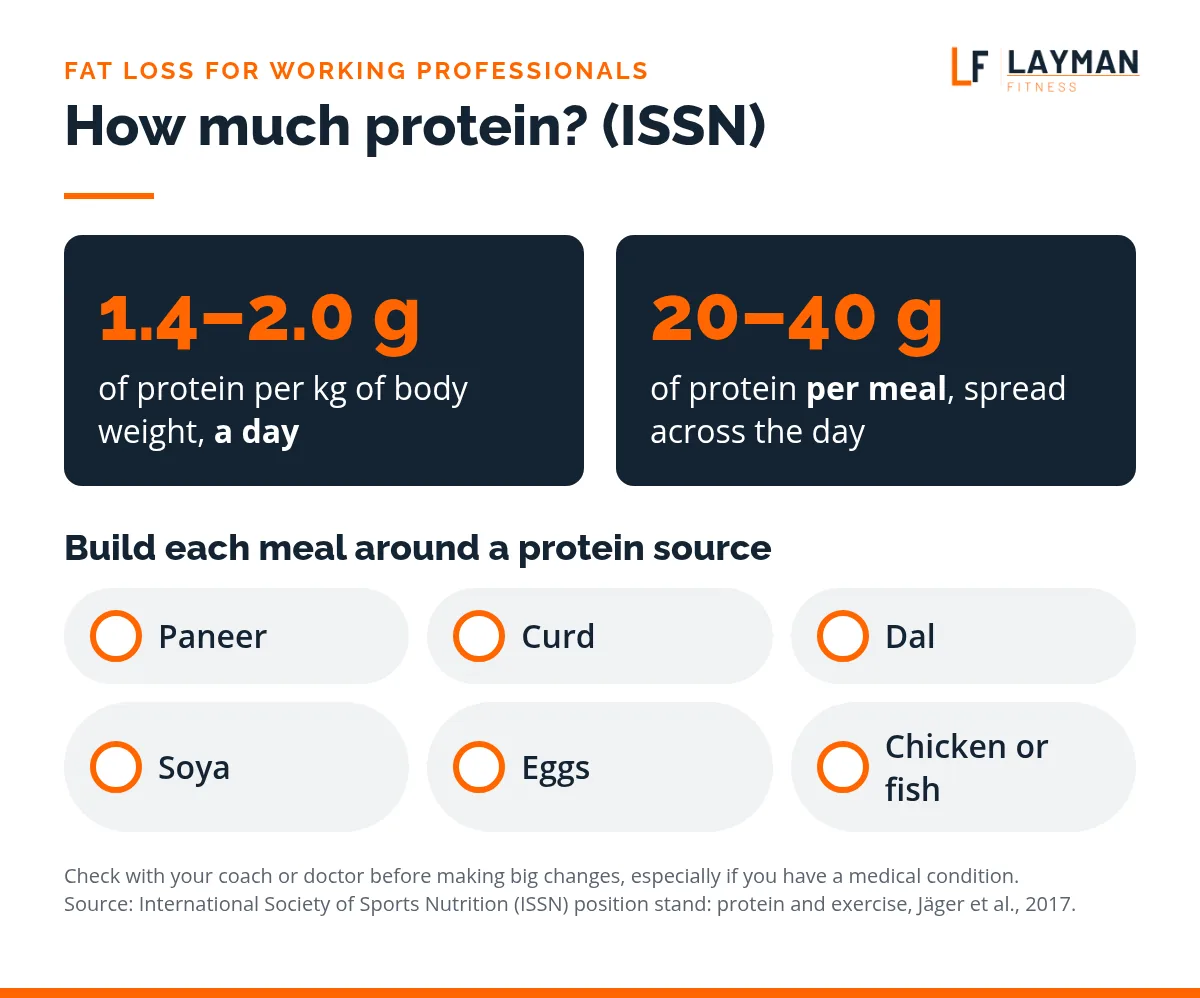
Practical Indian options:
- Vegetarian: whey protein powder, paneer, curd or hung curd, Greek yoghurt, milk, dal and chana, rajma, soya chunks, tofu, besan chilla, sprouts.
- Eggetarian: eggs or egg-white bhurji added to any of the above.
- Non-vegetarian: chicken, fish and lean meat.
A simple rule: build every meal around a protein source first, then add vegetables, then grains or rotis to suit your energy needs. Vegetarians often need to plan a little more, for example by adding a bowl of curd or a paneer or soya dish to a dal-and-roti meal.
Late dinners, office lunches, eating out and travel
- Late dinners: keep dinner lighter and protein-first, and have a protein-rich snack in the evening so you are not starving at 10 pm.
- Office lunches: choose the dal, curd, paneer or chicken option and go easy on fried sides.
- Eating out: pick one indulgence (starter, dessert or drinks), not all three.
- Travel: pack protein snacks such as roasted chana, and use hotel walks and bodyweight sessions to stay on track.
Workout before or after office?
The best time is the one you can repeat every week. Morning sessions protect training from late meetings and leave the evening free. Evening sessions suit people who are not morning people or who sleep badly when they wake early. If you train in the evening, keep it at least a little away from bedtime and keep the session focused. If you train early, give yourself a short warm-up, because you will feel stiffer.
Try one slot for four weeks before deciding it does not work.
Sleep and stress: the part most plans ignore
Sleep is part of the plan, not an extra. The US Centers for Disease Control and Prevention (CDC) recommends 7 or more hours of sleep a day for adults aged 18-60. The CDC also lists habits that help: going to bed and getting up at the same time every day, turning off electronic devices at least 30 minutes before bed, avoiding large meals and alcohol before bedtime, and avoiding caffeine in the afternoon or evening.

For stress, small things add up: a walk between meetings, a few minutes of slow breathing, and one evening a week with no work messages. You cannot remove work stress, but you can stop it from deciding what you eat and whether you train.
“The best time to go to bed depends on when you have to wake up. Count back eight hours: if you need to be up at 7 AM, you need to be in bed by 11 PM. Then shut everything down two hours before that, so your head gets time to slow down with no stimulation. Read a book for ten minutes, take a hot shower, brush, and plan your day. Most importantly, do a brain dump: sit down with a diary and write out tomorrow’s to-dos. If thoughts keep bombarding your brain, it’s hard to sleep, so put them all down on paper and go to bed relaxed.” — Pankaj Narsian, Head Coach, Layman Fitness
How to track progress without obsessing over the scale
Body weight goes up and down day to day with water, salt and digestion. Track a few things together:
- Weekly average weight: weigh yourself a few mornings a week and compare weekly averages, not single days.
- Waist measurement: measure at the same spot every two weeks.
- Photos: same light, same pose, every few weeks.
- Strength: are your lifts going up, or are reps getting easier?
- Energy, sleep and hunger: note them weekly. They tell you whether the plan is sustainable.
If two or three of these are moving the right way, the plan is working, even when the scale is slow.
When to get a coach
You can run this plan on your own. A coach helps when you keep starting and stopping, when you are not sure your form is right, or when work and travel keep throwing you off. Good online coaching gives you accountability, a programme built for your schedule and equipment, and video feedback on your lifts.
At Layman Fitness, coaching is fully online and built on three pillars: Accountability, Personalised Training and Metabolic Health. You get your programme in the CoachRx app, weekly or bi-weekly calls, weekly video feedback on your training and a weekly nutrition and lifestyle check. Read more about our online fitness coaching and how our check-ins and form reviews work, or read client stories. Our free Layman Fat Loss Blueprint is on the resources page. If you are still deciding whether coaching is for you, see our related read, is online coaching worth it.
Pricing: 3-month programme ₹25,000 and 6-month programme ₹45,000, both paid upfront in INR.
“My consistency has improved more than ever before, and that has been a game changer.” — Namita Shirgaonkar, Client Partner, ABC Consultants
Want a plan built around your week? Tap the WhatsApp button on our site and tell us your schedule and your goal. We will tell you honestly whether coaching makes sense for you.
FAQs
How can a working professional lose fat with no time?
Train strength two or three times a week for 45-60 minutes, walk more every day, eat protein at each meal and keep a modest calorie deficit. That fits into about three hours of training a week.
How many days a week should I work out to lose fat?
Two or three full-body strength sessions a week is enough for most busy people, combined with daily walking. More is not better if it costs you sleep or consistency.
How fast should I expect to lose fat?
Everybody is different, but many clients feel and see changes within 6-9 weeks, with deeper transformation happening over 12-15+ weeks. (From the coaching experience of Pankaj Narsian, Head Coach, Layman Fitness.) Track waist, photos and strength alongside the scale.
Are steps enough to lose fat, or do I need the gym?
Walking helps you burn more energy, but strength training helps you keep muscle while you lose fat. The best results come from doing both, alongside sensible eating.
How do I lose weight if I eat dinner late?
Keep dinner lighter and protein-first, have a protein-rich evening snack so you are not over-hungry, and look at your total intake across the day rather than the clock.
Can I lose fat with only home workouts?
Yes. A pair of dumbbells, a band and your body weight are enough to train every major movement pattern. What matters is that the work gets gradually harder over time.
Sources
- Jäger R, Kerksick CM, Campbell BI, et al. “International Society of Sports Nutrition Position Stand: protein and exercise.” Journal of the International Society of Sports Nutrition (BioMed Central), 20 June 2017. https://jissn.biomedcentral.com/articles/10.1186/s12970-017-0177-8
- Centers for Disease Control and Prevention (CDC). “About Sleep.” CDC, 15 May 2024. https://www.cdc.gov/sleep/about/index.html
- World Health Organization (WHO). “Physical activity” (fact sheet). WHO, 26 June 2024. https://www.who.int/news-room/fact-sheets/detail/physical-activity