

To keep exercising while travelling for work, plan short sessions around your travel calendar, not your ideal week. A short bodyweight workout in your hotel room, daily walking, and keeping meals and sleep close to your normal routine are enough to hold your progress until you’re home. That is how to exercise while traveling for work; the rest of this guide shows you how.
If you train well at home, only for a work trip to break your routine and set you back for weeks, this guide is for you.
The short answer: aim to hold your progress, not to set records
A work trip is not the week to chase a personal best. It’s the week to keep the habit alive. The minimum is smaller than most people think. The CDC, the US public health agency, says adults need at least 150 minutes of moderate-intensity activity a week, such as 30 minutes a day on 5 days, plus muscle-strengthening activity on 2 or more days that works all the major muscle groups. The WHO uses the same 150-minute minimum worldwide, so it applies just as well to adults in India. You can split it into short chunks, and in the WHO’s words, “all physical activity counts”.
A brisk walk to your meeting and two short hotel-room sessions make a good trip, not a failed one.
Plan training around your travel calendar
Personalised training means planning for the week you actually have. Before the trip, mark three kinds of days in your calendar:
- Before you fly: train hard at home, so you leave with your progress banked.
- Travel days: go light. A walk through the airport and an early night are enough.
- Room days and gym days: look up the hotel gym before you book, then decide which days you’ll use it and which days you’ll train in your room.
Book each session like a meeting. A 30-minute slot before breakfast is easier to protect than “sometime in the evening”, when client dinners take over.
My advice: always have a basic travel programme ready before you travel. Then practise its movements on your regular training days, so that when you have to do them on the road, they don’t feel uncomfortable. I say this because it’s easy to put off workouts when the movements feel unfamiliar. If the routine is already practised, there’s less chance you’ll skip it.
The hotel room workout (no equipment)
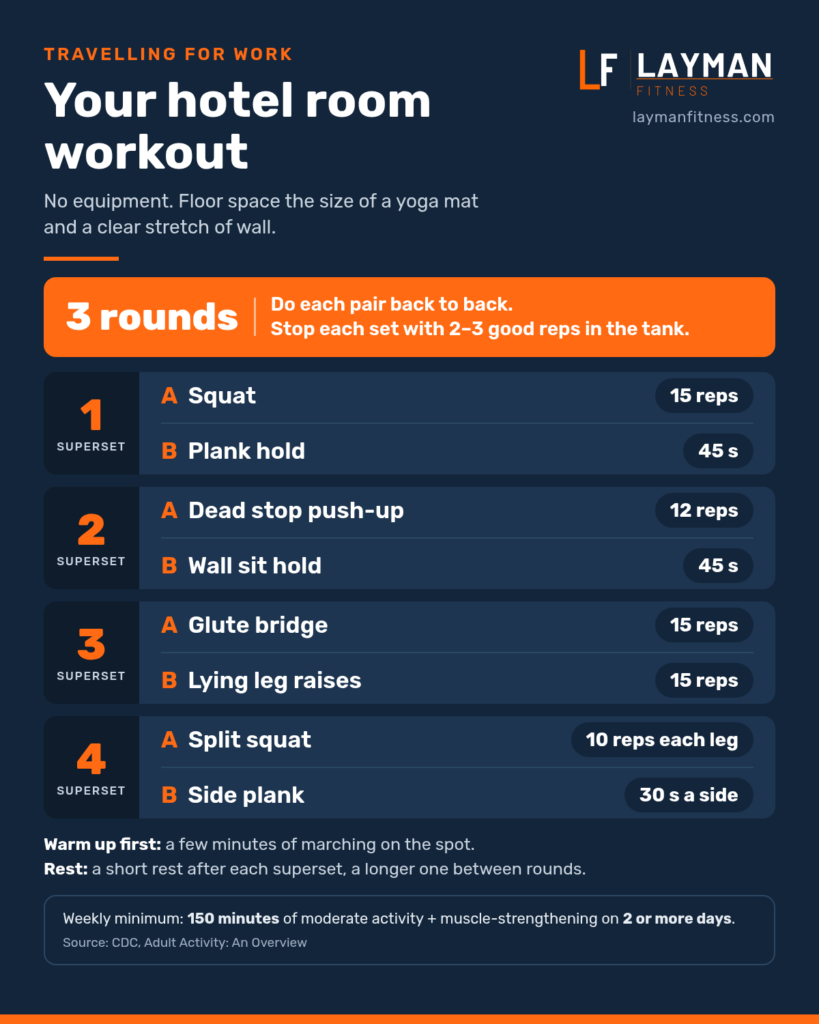
You need floor space the size of a yoga mat and a clear stretch of wall. Warm up for a few minutes by marching on the spot, then start.
The circuit
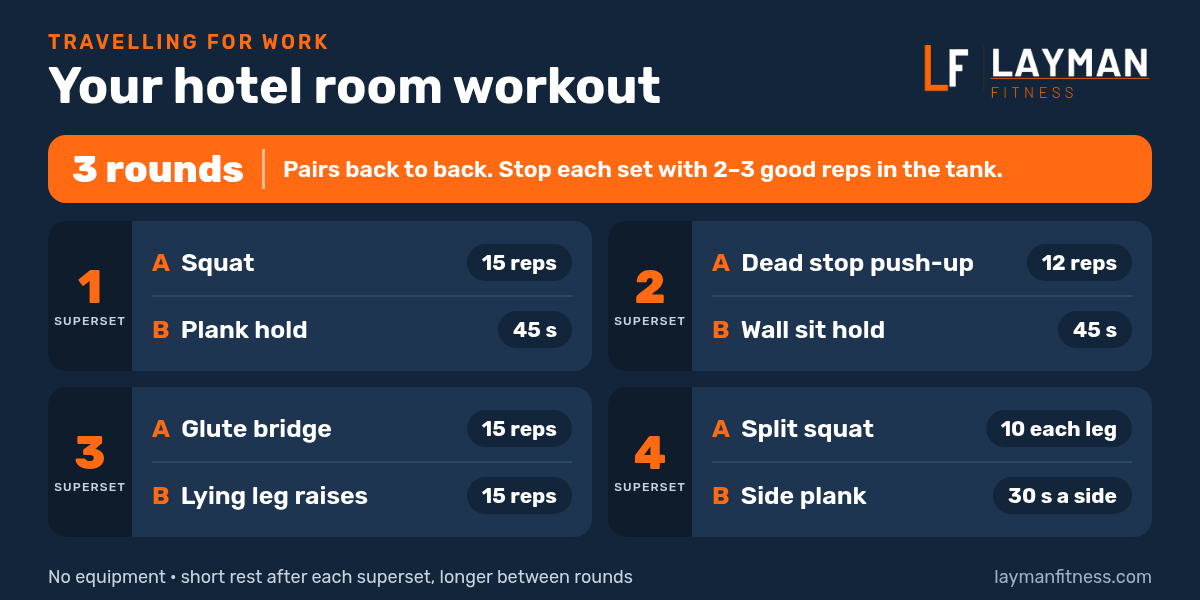
Do 3 rounds of the four supersets below: the two moves back to back, then a short rest, and a longer one between rounds. Stop each set with 2 or 3 good reps still in the tank. Most demos are from our YouTube channel.
- Superset 1: squat, 15 reps + plank hold, 45 seconds. Squat: feet about shoulder-width apart, sit down and back as if into a chair, then stand tall. Easier: squat to the edge of the bed. Demo. Plank: forearms under your shoulders, body straight. Easier: knees down. Demo.
- Superset 2: dead stop push-up, 12 reps + wall sit hold, 45 seconds. Dead stop push-up: lower all the way down, pause with your chest on the floor and release, then press up. Easier: from your knees, or hands on the desk or bed edge. Demo. Wall sit: back flat on the wall, thighs nearly parallel to the floor. Easier: don’t go as low. Demo.
- Superset 3: glute bridge, 15 reps + lying leg raises, 15 reps. Glute bridge: on your back, knees bent, drive through your heels to lift your hips. Easier: lift partway. Demo. Lying leg raises: lower back pressed down, slowly raise and lower straight legs. Easier: bend your knees. Demo.
- Superset 4: split squat, 10 reps each leg + side plank, 30 seconds a side. Split squat: one foot forward, one back, lower your back knee towards the floor and push back up. Easier: hold the wall or a chair for balance. Demo. Side plank: elbow under your shoulder, hips lifted in a straight line; switch sides. Easier: bottom knee down. Demo.
Hotel gym days vs room days
Check the gym photos first, and keep the room workout as your fallback.
On a gym day, keep the four supersets and add a dumbbell where it fits: at your chest for the squat, across your hips for the glute bridge, one in each hand for the split squat. If the dumbbells are light, lower slowly.
On a room day, do the circuit. Short on time? Just do one round. One round done always beats a full session left on paper.
How to exercise with jet lag
Jet lag happens when your body clock and local time no longer match. India to Dubai is a small time shift; India to Singapore, Tokyo, London or Frankfurt crosses several hours. According to the CDC Yellow Book, most people adjust faster after flying west than after flying east, so a trip east (Singapore, Tokyo) usually takes longer to settle into than a trip west (London, Frankfurt).
The CDC’s general tips:
- Before you fly: in the 2–3 days before the trip, move your bedtime about an hour per day towards the destination’s time: later if you’re flying west, earlier if you’re flying east.
- On the plane: time your meals and sleep to the destination’s clock. Drink plenty of water and go easy on alcohol.
- When you land: get outside in daylight. If you need a nap, keep it short (the Yellow Book suggests 20–30 minutes), because long daytime naps make it harder to sleep at night.
- Short trips: for trips of less than about 2 days, the Yellow Book suggests keeping to your home time zone rather than trying to adjust.
Where does exercise fit? CDC’s travellers’ page on jet lag suggests using exercise to help you stay alert during the day, but not in the evening. Our coaching rule: keep arrival-day training light. A walk outdoors in the morning light, or one easy round of the circuit, is plenty. Save harder sessions for after a proper night’s sleep.
If you have a health condition, or jet lag hits you hard, speak to your doctor before you travel.
Eating on the road: hotel breakfasts, client dinners, airport food
Metabolic health on a work trip is won or lost at the table more than in the gym. You don’t need to count anything:
- Hotel breakfast: protein first. Start at the egg counter, then add dahi, sprouts or fruit, before deciding on parathas or a second plate of poha.
- Client dinners: plan them. Pick a protein dish, such as tandoori chicken, grilled fish, paneer tikka or dal, with vegetables. Decide how many drinks you’ll have before you sit down.
- Airport food: keep it simple. An egg, chicken or paneer sandwich, or roasted chana and fruit, beats a pastry and a sugary coffee.
- Water all day. Fill a bottle after security.
As with training, aim to stay close to how you eat at home, not to be perfect.
Getting back on track after the trip
A work trip rarely costs you your progress. What sets you back is the two weeks after it, when “I’ll start Monday” keeps rolling forward. Two rules:
- Train on your first full day home. Make it a normal session, a little lighter if you’re tired.
- Never miss twice. One missed workout is life. Two in a row is the start of a new habit you don’t want.
Consistency over months is what changes your body, as our guide to fat loss for working professionals on 3 hours a week explains.
How online coaching plans around your trips
Accountability helps: the hotel session is easier when someone expects to see it. At Layman Fitness, coaching is fully online and built on three pillars: Accountability, Personalised Training and Metabolic Health. We’re based in India and work with clients wherever they are.
You start with a free discovery call, and if it’s a good fit, you enrol after that. Your programme lives in CoachRx on your phone, so it travels with you. Every week you get a video call and written feedback on CoachRx, and we adjust your plan to fit your work and travel. See how our online fitness coaching works, or see whether online fitness coaching is worth it for you.
Travel a lot for work? Book a 20-minute discovery call via the Coaching Application form and we’ll build your training around your trips, not the other way round.
FAQ
How do I keep working out when I travel for work?
Plan sessions around your travel calendar before you leave. Train hard before you fly, go light on travel days, and decide which days are hotel-gym days and which are room days. Put each short session in your calendar like a meeting, and walk whenever you can. Short sessions still count.
What is a good hotel room workout with no equipment?
Four bodyweight supersets: squats with a plank, dead stop push-ups with a wall sit, glute bridges with leg raises, and split squats with a side plank. Each move has an easier option, and you need only a yoga mat’s worth of floor and a stretch of wall.
Should I exercise when I have jet lag?
Yes, but keep it light on the day you arrive. A morning walk in daylight or one easy round of a bodyweight circuit is enough. CDC’s travellers’ advice suggests using exercise to stay alert during the day and avoiding it in the evening. Save harder sessions until you’ve slept well.
How much exercise do I need in a week while travelling?
The same as at home. The CDC and the WHO say adults need at least 150 minutes of moderate activity a week, and the CDC adds muscle-strengthening on 2 or more days. You can split it into short chunks, so daily walking plus two short hotel sessions covers most of it.
How do I eat healthily on a business trip?
Keep it simple and close to how you eat at home. Start hotel breakfasts with protein, such as eggs or dahi. Plan client dinners around a protein dish and vegetables, and decide how many drinks you’ll have before you sit down. Carry water, and pick simple airport food over pastries.
How do I get back into training after a work trip?
Train on your first full day home, even if it’s a lighter session than usual, and never miss two workouts in a row. Don’t wait for Monday or try to make up for lost sessions. Pick up your normal plan where you left off and build back over a week.
Sources
- CDC Yellow Book 2026: Health Information for International Travel. Jet Lag Disorder (Samantha M. Riedy and Scott G. Williams), 23 April 2025. Checked live 10 Nov 2026. https://www.cdc.gov/yellow-book/hcp/travel-air-sea/jet-lag-disorder.html
- CDC Travelers’ Health. Jet Lag. Page last reviewed 6 October 2022. Checked live 10 Nov 2026. https://wwwnc.cdc.gov/travel/page/jet-lag
- CDC. Adult Activity: An Overview, 20 December 2023. Checked live 10 Nov 2026. https://www.cdc.gov/physical-activity-basics/guidelines/adults.html
- World Health Organization. Physical activity (fact sheet), 4 November 2026. Checked live 10 Nov 2026. https://www.who.int/news-room/fact-sheets/detail/physical-activity